

Boat Storage Management Software: What Features Should You Look For?
Boat storage management software helps facility owners automate billing, track unit availability, and manage seasonal tenants without drowning in paperwork. Running a boat storage yard is different from a standard mini-storage site. You deal with irregular unit shapes, seasonal demand spikes, and customers who need quick access during peak boating months.
The right boat storage management software removes the daily headaches of manual tracking. It connects billing, gate access, and customer communication into one dashboard. Facility owners who switch from spreadsheets to dedicated software report fewer late payments and faster move-ins. This guide breaks down exactly what features matter most before you buy.
Quick Feature Comparison Matrix
| Feature | Why It Matters | Priority Level |
| Online reservations | Captures leads 24/7 without staff | High |
| Automated billing | Cuts late payments, saves admin time | High |
| Gate access control | Reduces theft, tracks entry logs | High |
| Mobile app access | Lets owners manage sites remotely | Medium |
| Dynamic unit mapping | Handles irregular boat/RV bay sizes | High |
| Insurance tracking | Flags expired tenant coverage | Medium |
| Multi-site reporting | Useful for owners with several yards | Medium |
| RV & boat combo support | Manages mixed-use facilities | High |
Why Boat Storage Facilities Need Specialized Software
Standard self-storage tools were built for indoor units with fixed dimensions. Boat storage doesn’t work that way.
Your yard likely has:
- Covered and uncovered spaces
- Different bay lengths for boats, trailers, and RVs
- Seasonal move-in surges before summer
- Customers needing drive-up access at odd hours
Generic software forces you to work around these gaps. Purpose-built boat storage management software handles them out of the box.
Core Features Every Owner Should Demand
Flexible Unit and Space Mapping
Your software needs to track irregular spaces, not just 10×10 boxes. Look for tools that let you customize bay length, width, and vehicle type.
This matters even more if you run a mixed facility. Many yards combine boat & RV storage management under one roof, so the software must handle both asset types in a single system.
Automated Billing and Payment Collection
Manual invoicing eats hours every week. Automated billing sends reminders, charges recurring payments, and flags overdue accounts without staff intervention.
Look for software that supports:
- Auto-pay enrollment
- Late fee automation
- Multiple payment methods (ACH, card, cash logging)
- Prorated billing for mid-month move-ins
Billing errors also create compliance risk. This detailed breakdown on security and billing automation fixes shows how automation closes common gaps that cost owners money.
Gate Access and Security Integration
Boats and RVs are high-value assets sitting outside overnight. Your software should sync with gate access systems so only paying tenants can enter.
Key security features to check:
- Individual access codes per tenant
- Entry and exit logs
- Automatic access shutoff for unpaid accounts
- Camera system integration
Online Reservations and Waitlists
Most boat owners search for storage online before ever calling. If your site can’t book a reservation instantly, you lose that lead to a competitor.
Good software includes:
- Real-time availability display
- Instant online booking
- Automated waitlist notifications when space opens
Reporting and Multi-Site Management
If you manage more than one yard, you need visibility across all locations from a single login. Strong reporting tools show occupancy rates, revenue trends, and delinquency patterns at a glance.
This becomes critical as you scale. Owners running both RV storage management software and boat-specific tools separately often end up with duplicate data entry and mismatched reports.
How Boat Storage Software Improves the Tenant Experience
Tenants expect the same convenience they get from other online services. A clunky sign-up process pushes them to a competitor down the road.
Modern platforms improve the tenant journey through:
- Self-service account portals
- Text and email payment reminders
- Digital lease signing
- Mobile-friendly booking pages
For a deeper look at how these upgrades affect renter satisfaction, this guide on tenant experience improvements covers the data behind it.
Choosing Boat Storage Management Software for Your Local Market
Search behavior for storage is highly local. A boater in Tampa searches differently than one in Seattle, but both want fast, mobile-friendly booking.
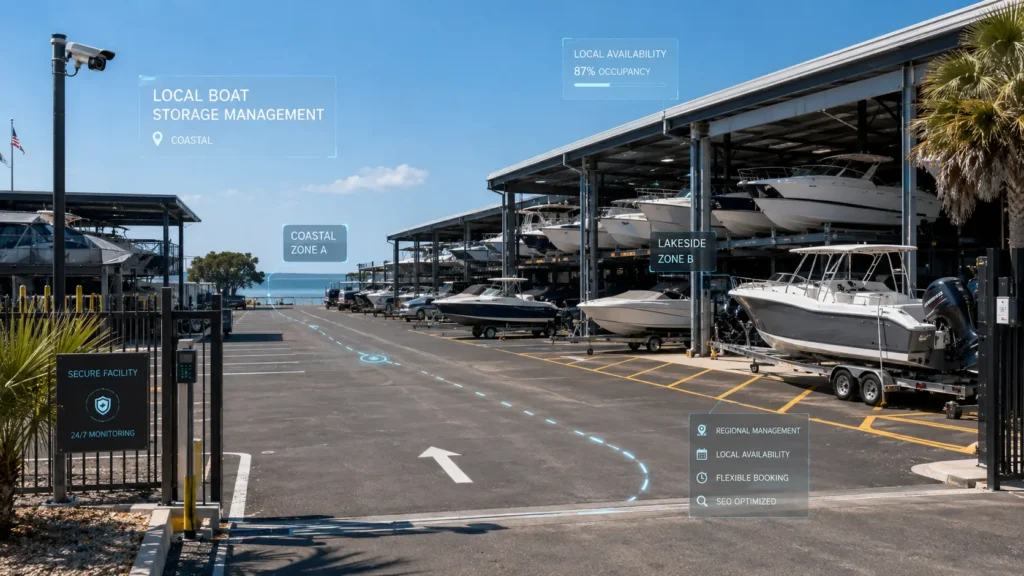
When picking a platform, confirm it supports:
- Location-based SEO tools for your facility page
- Local tax rate configuration
- Region-specific insurance requirements
- Multi-language support if your market needs it
Choosing the right boat storage management software for coastal and lakeside facilities means picking a system built to handle regional demand swings, not a generic one-size-fits-all tool.
What It Costs to Implement This Software
Pricing varies based on facility size, number of units, and feature depth. Most vendors charge a monthly subscription based on unit count rather than a flat fee.
Before signing a contract, ask about:
- Setup and onboarding fees
- Per-unit vs. flat-rate pricing
- Contract length and cancellation terms
- Add-on costs for gate integration or SMS alerts
New owners often underestimate hidden costs during their first software purchase. This resource on software costs for new storage owners breaks down what to budget for realistically.
Accounting and Financial Integration
Your storage software shouldn’t operate in isolation from your books. Look for direct integration with accounting platforms like QuickBooks or Xero.
This integration should support:
- Automatic revenue syncing
- Tax report generation
- Expense tracking per site
- Reconciliation without manual data entry
Poor accounting sync is one of the top reasons owners switch platforms mid-year. This guide on accounting integration for storage software explains what to check before you commit.
Red Flags to Avoid When Evaluating Vendors
Not every platform marketed as “storage software” fits boat and RV facilities well. Watch for these warning signs during demos:
- No support for irregular unit sizes
- Limited or no mobile app
- No live customer support during setup
- Vague pricing that hides per-transaction fees
- No seasonal billing flexibility
Ask vendors direct questions during your trial period. A platform that can’t answer clearly about gate integration or seasonal rate changes probably wasn’t built for outdoor storage.
FAQs
Does boat storage software work for mixed boat and RV facilities?
Yes, most modern platforms support mixed-use yards with customizable unit types for boats, RVs, and trailers in one system. Check that the vendor specifically lists combo support before buying.
How much does boat storage software typically cost per month?
Pricing usually ranges from $1 to $3 per unit monthly, depending on features included. Larger facilities often get volume discounts on per-unit rates.
Can I manage gate access remotely with this software?
Yes, most platforms let owners lock, unlock, or revoke tenant access remotely through a mobile app or web dashboard. This is especially useful for owners managing multiple sites.
Is cloud-based software safer than on-site systems?
Yes, cloud-based platforms back up data automatically and reduce risk from local hardware failure or theft. On-site systems require manual backups and are harder to access remotely.
Do tenants need to download an app to pay online?
No, most platforms use a web-based tenant portal that works directly in a browser. Some offer optional apps, but they aren’t required for payment.
How long does it take to switch software providers?
Most migrations take two to four weeks, depending on data volume and integration needs. Ask your new vendor about data migration support before signing.
Can this software handle seasonal rate changes automatically?
Yes, quality platforms let you schedule rate adjustments in advance for peak boating season. This removes the need to manually update pricing every quarter.
What happens if a tenant’s payment fails?
Good software automatically retries the payment, sends a notification, and can trigger access suspension after a set grace period. This reduces manual follow-up work for staff.
Does the software integrate with insurance verification?
Many platforms flag expired insurance documents and send renewal reminders automatically. This helps owners stay compliant without tracking policies manually in spreadsheets.
Conclusion
Picking boat storage management software comes down to matching features to your actual daily operations. Focus on flexible unit mapping, automated billing, and strong security integration before anything else.
Don’t get distracted by flashy extras if the core basics are weak. Test the reservation flow, check accounting integration, and confirm the vendor understands seasonal storage demand. A well-matched system pays for itself through fewer missed payments and faster tenant sign-ups within the first few months.

Leave a Reply