
How to Automate Self Storage: A Step-by-Step Guide
You automate self storage by connecting a property management system, keyless gate access, auto-billing, and a tenant portal. This lets units rent, unlock, and get paid for without staff at a front desk. That’s exactly what most owners searching how to automate self storage want to know first.
Renters today expect the same speed they get from Amazon or Uber. They don’t want a callback tomorrow. Facility owners who make this shift cut payroll costs and stop chasing late rent by phone. They also get hours back to grow the business instead of manage it.
Manual facilities lose money in ways owners rarely notice. A missed after-hours call often becomes a lost rental. Automated facilities catch those gaps and turn them into recurring revenue instead.
Below is a matchup table showing which automation level fits your facility size. After that, every system worth automating and real questions storage owners ask most.
Which Automation Level Fits Your Facility?
| Facility Type | Recommended Automation | Estimated Payback Time |
| Single-site, owner-operated | Online rentals, autopay, keyless entry | 3–6 months |
| Small chain (2–5 sites) | PMS + remote call center + dynamic pricing | 4–8 months |
| Mid-size REIT-style portfolio | Full PMS, marketing automation, revenue management software | 6–12 months |
| Legacy manual facility (converting) | Phased rollout: billing first, access second | 8–14 months |
Why Self Storage Automation Isn’t Optional Anymore
Renters compare storage to streaming and online shopping. They want instant confirmation, not a “call during business hours” message.
Facilities that skip automation lose bookings to competitors offering contactless move-in at 11 p.m. on a Sunday. Most new renters research and reserve units online before ever picking up the phone.
Automating self storage has become the baseline for staying competitive. It’s not a bonus feature reserved for bigger operators anymore.
Core Systems to Automate First
Property Management Software (PMS)
Your PMS is the backbone of the whole setup. It centralizes tenant data, billing, lease documents, and occupancy tracking in one dashboard instead of scattered spreadsheets.
A strong starting point is switching to automated self-storage software systems built specifically for the industry, not a generic property tool with storage bolted on.
Online Rentals and Digital Lease Signing
Customers browse units, check real-time pricing, and sign a digital rental agreement without visiting the office. This converts late-night browsers who’d otherwise call a competitor the next morning.
Auto-Billing and Payment Collection
Recurring billing removes the need for staff to chase rent every month by phone. Autopay also lowers delinquency since tenants don’t have to remember due dates.
Keyless Access Control
Gate codes, mobile app unlocks, or Bluetooth entry replace physical keys entirely. When a tenant falls behind on payment, access shuts off automatically without a manual phone call.
Remote Monitoring and Call Support
Cameras paired with software alerts flag unusual activity even when nobody’s on-site. Many owners pair this with a remote call center so calls still get answered after hours.
Digital Lien and Compliance Notices
Every state has different lien laws for delinquent units. Good software tracks deadlines and fires off compliant notices automatically, cutting legal exposure.
How to Automate Self Storage Without Overspending
Not every platform needs every feature on day one. Match your automation spend to your biggest pain point first, whether that’s late payments, staffing costs, or slow lease-ups.
Cloud-based platforms matter most for multi-site owners who want one login instead of juggling separate accounts per facility.
Must-Have Features Checklist
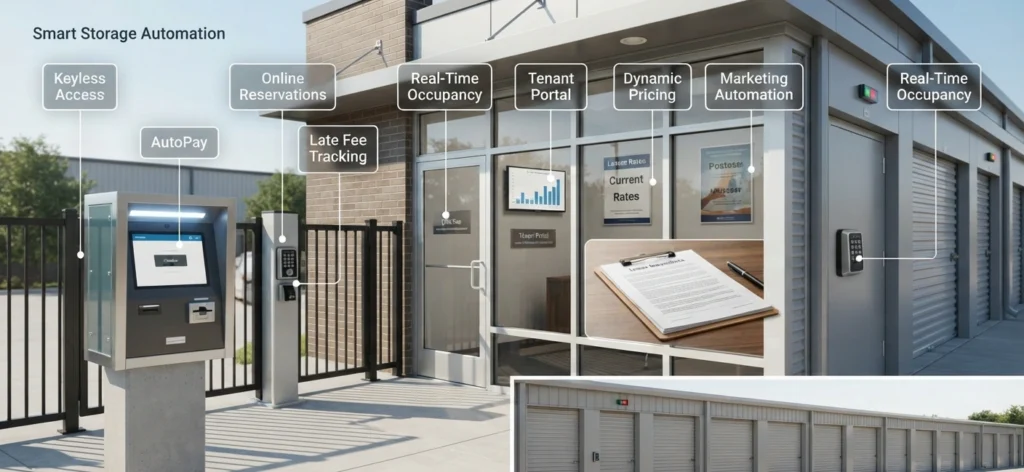
- Integrated payment processing with autopay
- Gate and keyless access control integration
- Online reservation with digital lease signing
- Automated late fee and lien tracking
- Real-time occupancy dashboard
- Tenant-facing mobile app or portal
- Revenue management and dynamic pricing reports
- Marketing and lead follow-up automation
Revenue Management and Dynamic Pricing
Automation isn’t only about cutting labor hours. It also unlocks smarter pricing decisions.
Dynamic pricing tools adjust unit rates based on occupancy, demand, and season. This works the same way hotels and airlines price rooms and seats.
Owners who automate self storage pricing strategies typically see occupancy stabilize faster than facilities stuck on flat, static rates.
Staffing Models: Unmanned, Hybrid, or Reduced-Hours
Full automation doesn’t always mean zero staff on payroll. Many owners run a hybrid model with a remote team backing up self-service tools.
- Unmanned facility: No on-site staff; app or kiosk handles everything
- Hybrid model: Remote call center covers overflow calls and edge cases
- Reduced-hours model: Staff on-site part-time, automation covers the rest
This flexibility lets owners scale staffing down gradually instead of an all-or-nothing switch.
Common Mistakes Owners Make
- Skipping tenant communication during the transition, causing confusion
- Choosing software without local lien-law compliance built in
- Leaving access control disconnected from billing systems
- Underestimating the need for backup support during outages
- Automating pricing without reviewing local market rates first
What Automation Actually Saves You
Labor is usually the biggest line item after mortgage or rent at a self storage facility. Automating rent collection, access, and support can shrink a full-time front desk role down to occasional oversight.
Fewer manual errors also mean fewer refunds, billing disputes, and awkward calls. Over a year, that adds up to real, countable savings on top of higher occupancy.
FAQs
Is it worth automating a small self storage facility?
Yes, even small facilities benefit since automation cuts the need for full-time staff. A single owner-operator can manage bookings, payments, and access remotely without hiring extra help.
How much does self storage automation cost?
Costs vary by provider and facility size, usually running as a monthly subscription based on unit count. Most owners recover this cost within months through labor savings and fewer missed payments.
Can I automate an existing facility without renovating it?
Yes, most keyless access systems retrofit onto existing gates and doors without major construction. Software-based automation like billing and online rentals needs no physical changes at all.
What happens if the internet goes down at an automated facility?
Good software providers offer offline backup modes for access control during outages. Cloud-based billing still processes once the connection restores, so no payments get lost.
Do tenants like unmanned storage facilities?
Most tenants prefer the convenience of 24/7 access and self-service move-in over waiting for office hours. Some older or less tech-comfortable renters may still want a staffed option nearby.
Is dynamic pricing risky for self storage facilities?
No, when set up correctly dynamic pricing just adjusts rates based on demand and occupancy trends. It’s the same strategy hotels and airlines already use, applied to storage units.
Can automation work for multi-facility owners?
Yes, cloud-based platforms let owners manage several locations from a single dashboard. One manager can oversee multiple sites remotely, which is where the biggest labor savings show up.
What’s the first step to automate self storage operations?
Start with online rentals and auto-billing since these touch revenue directly. Once those run smoothly, add keyless access and reporting tools as the next phase.
Conclusion
Getting self storage automation right comes down to picking the right combination of a solid PMS, keyless access, auto-billing, and dynamic pricing tools. Start with systems that touch revenue directly, like payments and lease signing, before adding secondary features like marketing automation.
Owners who set up how to automate self storage properly see faster payback than those who buy random tools without a plan. The goal isn’t just less work for staff, it’s a facility that runs profitably even when nobody’s standing at the desk.
Automation pays for itself through lower labor costs, fewer missed payments, and smarter pricing decisions over time. If you’re still running your facility with spreadsheets and phone calls, now’s the time to change that before competitors pull further ahead.
Every piece, from gate access to lien notices, works better connected than scattered across separate tools. A good next step is comparing options at 6storage.com before you commit to a provider.

Leave a Reply